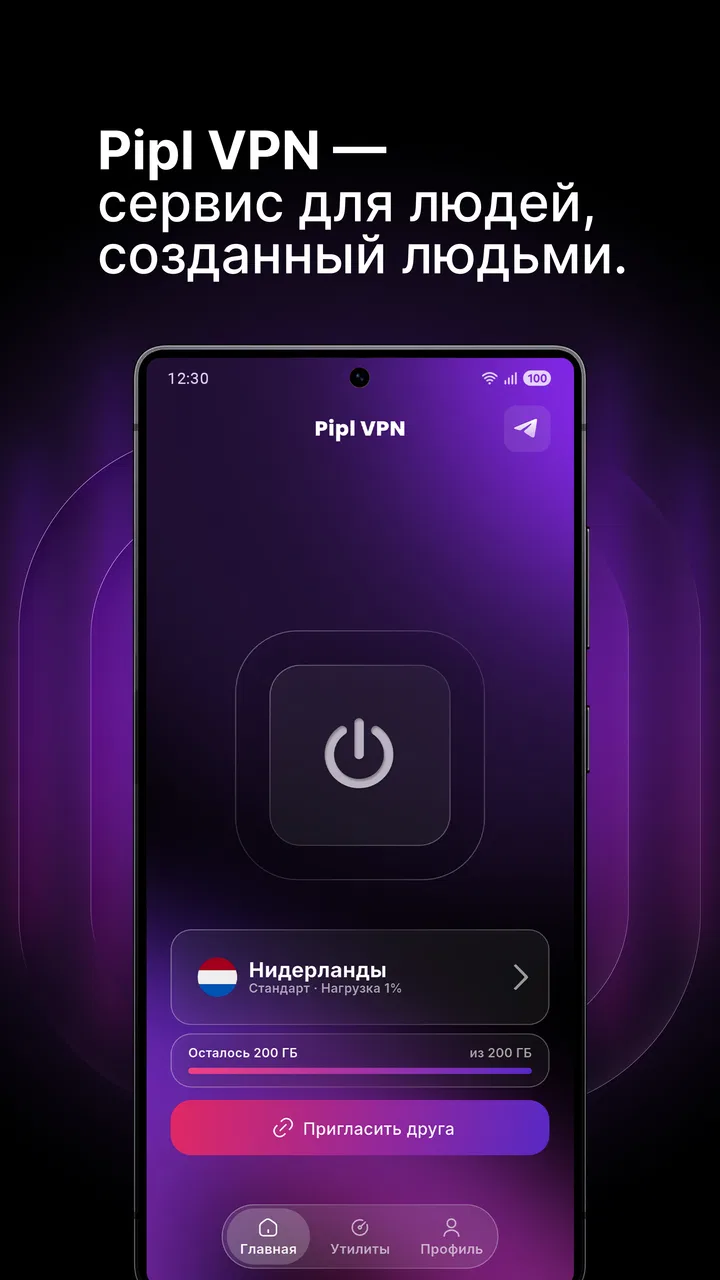
Pipl VPN: рабочий впн
- 4.8
- Rating
- 5.00M
- Installs
- Free
- Price

 Analysis by App-foxy
I spend a lot of time switching between public Wi-Fi, mobile data, and home networks, so I judge a VPN less by its promises and more by how little trouble it creates during an ordinary day. Pipl VPN: рабочий впн is a free tools app from PIPL NETWORK LLC that aims to make that switch easier while adding a layer of privacy. My first impression is that it is built for people who want a straightforward connection rather than a long list of technical controls.
The important question is not simply whether a VPN connects. It is whether the connection remains usable when I open a map, send photos, join a call, or move from one network to another. This app has a 4.7 average from around 98 thousand ratings and more than five million installs, which suggests that plenty of people find its simple approach worthwhile. Still, those figures do not replace testing it against your own network, location, and habits.
How the connection feels in everyday use
In my experience, a VPN should be judged against the connection you already have, not against an imaginary perfect network. Any VPN can add a little distance between your device and the service you are using. That means the most realistic expectation here is not “faster internet,” but a usable connection that does not constantly interrupt normal browsing.
You May Also Like

 Blood Strike: 2.5 Anniversary
Blood Strike’s Loadouts Turn Every Drop Into a Tactical Gamble
A close look at Blood Strike’s custom loadouts: how fast access to signature weapons reshapes its battle royale rhythm, rewards preparation, and narrows the gap between fights.

 Pandora - Music & Podcasts
Pandora’s Music Is Easy to Start, but Harder to Recover
Pandora’s strength is its low-effort path from a seed to a station. Its weak spot is how much confidence it asks you to place in connection, setup, and quiet recovery.

 8 Ball Pool
 Is Built on Rivalries, Rematches, and Routine
A close look at the rivalries, rematches, shared routines, and unanswered safety questions that turn a quick pool match into a persistent mobile community.

 Samsung Music
’s Quiet Strength Is Playing What You Already Own
Its reach comes less from spectacle than from dependable access to a personal library. That simplicity is both the app’s strongest retention engine and its ceiling.

 AccuWeather: Weather Radar
AccuWeather Review: A Quick, Clear Forecast for Everyday Decisions
For everyday plans, the best forecast is the one you can understand quickly. AccuWeather makes rain timing, radar, and local conditions easy to act on, with a few trade-offs.

 Hill Climb Racing
Why Hill Climb Racing Still Turns Crashes Into One More Run
A tiny car, a bumpy hill and one more upgrade: Hill Climb Racing keeps resurfacing because its simple chaos makes every near-miss feel personal.
More From Our News Desk



The app’s appeal is its low-friction purpose. The store presents it as a secure, unlimited VPN service with free, stable internet access, while the short description simply calls it “Pipl VPN.” I read that as a sign that the main experience is meant to be uncomplicated: open the app, establish a connection, and continue with the task that brought you online.
That simplicity matters when I am on a café network and only need protection for a short session. I do not want to spend several minutes comparing technical settings before checking a bank notification or sending a work message. A tool that gets out of the way can be more useful than a sophisticated alternative if I am unlikely to configure that alternative correctly.
At the same time, I would not treat a free VPN as a magic speed enhancer. Video quality, downloads, online games, and large cloud transfers are all more sensitive to routing and congestion than ordinary text browsing. If your home connection is already slow, adding a VPN layer is unlikely to solve the underlying problem. I would start with modest expectations and decide whether the connection feels responsive enough for my particular routine.
What I would expect during heavier use
The difference between light and heavy use becomes obvious when several things happen at once. Reading articles and sending messages usually place little pressure on a VPN connection. Streaming high-resolution video, uploading a folder of photos, and keeping a video call active are more demanding because they need sustained throughput rather than brief bursts.
For those moments, I would use Pipl VPN selectively instead of leaving it connected without thinking. When I need privacy on an unfamiliar network, I would enable it before opening sensitive services. When I return to a trusted home network and begin a large upload, I would compare the experience with and without the VPN, provided the task does not require the extra protection. This simple habit helps separate the app’s performance from the quality of the underlying network.
A practical example is a train journey. I might connect to station Wi-Fi to download a document, answer messages, and check a route. Those are reasonable tasks for a lightweight VPN workflow. If I then decide to upload a long video while the same public network is busy, I would expect more variation and would avoid judging the whole app from that single demanding moment.
Another useful workflow is to connect before launching an app that handles personal information, rather than waiting until after it has already loaded. That reduces the chance of beginning a session on an unprotected connection. I would also avoid repeatedly toggling the VPN during a payment or account-login process, since a network change at the wrong moment can create its own inconvenience.
People who use a VPN mainly for gaming should be especially realistic. Competitive games are sensitive to delay and route changes, not just download speed. A connection that feels perfectly fine for browsing can still feel unsuitable for a fast multiplayer match. I would test a noncompetitive session first and keep a direct connection available if stable latency matters more than privacy for that particular game.
Stability matters more than a fast first connection
A quick connection at launch is useful, but I care more about what happens after the phone has been locked, the signal has changed, or another app has taken focus. Mobile users regularly move between Wi-Fi and cellular networks, and that transition is where a VPN can become frustrating if it does not recover cleanly.
My advice is to test the app during the transitions you actually experience. Connect on Wi-Fi, lock the phone, unlock it, and then move briefly to mobile data. Open a webpage after each change instead of assuming that the VPN state on screen tells the whole story. If a page does not load, I would disconnect and reconnect rather than repeatedly refreshing the same app.
This is also where a simple service can be easier to troubleshoot than a crowded one. There are fewer choices to second-guess, so the recovery routine is clear: check the connection indicator, reconnect, and retry the task. The trade-off is that users who want detailed control over routing or a large collection of specialized options may find that simplicity limiting.
I would not leave a VPN running blindly while diagnosing a network problem. If a website suddenly refuses to load, first switching the VPN off for a moment can tell me whether the issue is related to the tunnel or to the network itself. Once the cause is clear, I can reconnect and decide whether the protected connection is worth the small inconvenience.
That kind of recovery habit is more valuable than assuming every VPN session will remain perfect. Public networks disappear, mobile signals fluctuate, and apps can behave differently after a device wakes. Pipl VPN is most convincing when treated as a practical tool that I check when needed, not as something I never have to monitor.
Older devices and system requirements
The app supports Android starting with version 7.0, which gives it a broad reach across older Android phones and tablets. That is helpful for people who keep a reliable older device rather than replacing it every year. It also makes the app relevant in households where not every family member uses a recent handset.
Still, operating-system compatibility does not automatically mean identical performance on every supported device. Older hardware may have less memory, a weaker processor, or a battery that is already worn. Encryption and background networking can feel more noticeable on such phones, especially when the device is also handling navigation, music, and messaging.
I would install it on an older phone with a specific purpose first: protecting browsing on public Wi-Fi or keeping a secondary device safer while traveling. I would then watch for practical signs such as slower app switching, increased warmth, or faster battery loss. If those effects become distracting, I would use the VPN only for sensitive sessions instead of keeping it active all day.
On a newer phone, the main constraint is less likely to be basic compatibility and more likely to be the quality of the network path. A modern device cannot remove congestion from a crowded hotspot. This is why I prefer judging the app in the places where I actually need it, rather than assuming its behavior at home predicts what will happen in an airport, hotel, or public library.
The age rating is Everyone, so the app is positioned for general use rather than a narrowly restricted audience. I would still explain the basics to less technical family members: a VPN can help protect a connection, but it does not make every website trustworthy, replace careful password habits, or guarantee that every online service will work exactly as it does without one.
Where it fits beside other VPN choices
The usual alternative is a paid VPN with more visible controls, broader configuration, and a clearer focus on advanced users. That kind of service may be preferable when I need a particular location, detailed connection choices, or a predictable setup for work. Pipl VPN makes more sense when my priority is getting a free tool running without turning the process into a technical project.
Another alternative is simply using mobile data instead of public Wi-Fi. Mobile data can be convenient, but it may be expensive, unavailable indoors, or weak while traveling. In those situations, a VPN can make public Wi-Fi more comfortable to use. I would not confuse the two options, though: the VPN protects the connection path; it does not improve a poor signal or provide a replacement for internet access where no network exists.
Browser-based privacy tools are another partial substitute. They may cover web activity inside one browser, while a VPN app is intended to be considered at the device-connection level. For someone who moves between a browser, messaging apps, maps, and other services, a dedicated VPN workflow is more convenient. For someone who only wants to adjust browser privacy and dislikes background network tools, a browser option may feel less intrusive.
The free price is a major reason to try this app, especially for occasional public-network use. It also creates a trade-off: users who depend on a VPN for work, travel, or continuous high-bandwidth activity may reasonably prefer a service whose paid plan and support model match those demands. I would choose based on the consequence of failure. If a dropped connection merely delays casual browsing, this app may be enough; if it interrupts important work, I would compare more specialized options.
Small habits that make the app more useful
My first tip is to create a simple “connect before sensitive activity” routine. I would open the VPN before checking an account, sending a private document, or joining a call on unfamiliar Wi-Fi. This is more reliable than remembering halfway through the task, and it avoids treating the VPN as an emergency button after information has already traveled across the network.
Second, I would test one ordinary webpage immediately after connecting. That quick check confirms that the phone still has usable internet access and gives me an early warning if the current network does not cooperate. It is faster than discovering the problem when I am already in the middle of a form, call, or upload.
Third, I would keep a recovery sequence in mind: pause the current task, reconnect, then reopen the affected app if necessary. Some apps do not gracefully resume after a network path changes. Repeatedly tapping refresh can waste time and may create duplicate actions in services that submit forms or send files.
Fourth, I would use it deliberately during battery-sensitive days. If I am hiking with limited power, using navigation, taking photos, and relying on a weak signal, I would enable the VPN for tasks where privacy matters most rather than assuming every connection needs the same treatment. That is not a criticism of this particular app; it is a sensible compromise for any background network service on a constrained phone.
Finally, I would compare the connection in the exact place where I plan to use it. A VPN that feels smooth on a home router may behave differently on a crowded hotel network. One quick comparison of browsing, a short video, and an app login tells me more than a generic speed claim because it reflects my real route, device, and network conditions.
Who should use it, and who should look elsewhere
I think Pipl VPN is a good match for someone who wants a free, uncomplicated privacy tool for public Wi-Fi, occasional travel, and everyday browsing. It is also a sensible candidate for an older Android phone that still runs Android 7.0 or later, provided the owner is comfortable checking how battery and responsiveness feel during use.
I would be more cautious recommending it as the only VPN for a remote worker, a frequent traveler handling important accounts, or anyone who needs consistent performance for long downloads and calls. Those users should test recovery and sustained use carefully, and they may prefer a paid alternative with controls aimed at demanding workflows.
I would also skip it if my main goal were competitive gaming, guaranteed performance for high-bandwidth media, or fine-grained technical configuration. The app’s strength is approachability, not a promise that every specialized requirement will be covered. Choosing a simpler tool is sensible only when its simplicity matches the job.
My performance verdict
After looking at the way this app fits into real routines, I see its strongest point as convenience. It is free, broadly compatible with Android devices running version 7.0 or newer, and presented as a general-purpose tools app rather than a complicated networking console. The strong user response and five-million-plus install milestone make it an easy candidate to try, but I would still make the final decision from my own network experience.
Its performance should be judged in layers: light browsing first, then the public Wi-Fi situations where protection matters, and finally the heavier tasks I care about. That approach reveals whether connection changes, battery use, or recovery behavior are acceptable without relying on unrealistic expectations. In my case, that is a more honest test than asking whether a VPN is simply “fast.”
My recommendation is to use it as a practical, on-demand VPN rather than an unquestioned all-day solution. It can be a comfortable choice for casual users who want a free way to add protection when connecting away from home. I would keep a backup plan for important work, demanding downloads, and situations where stable latency is essential.
Overall, Pipl VPN: рабочий впн earns consideration because it focuses on the problem most people actually have: getting a VPN connection without a complicated setup. Its limitations are the same reason it is approachable; users looking for advanced control or highly predictable heavy-use performance should compare other options. For everyday public-network protection on a compatible Android device, I would install it, test it in my usual locations, and keep it available for the moments when a simple connection is exactly what I need.
FAQs for Pipl VPN: рабочий впн
01What is Pipl VPN: рабочий впн and how does it work?
Pipl VPN: рабочий впн is a virtual private network service that provides secure and private internet access. It encrypts your internet connection to protect your online activities from prying eyes, including hackers and data trackers. By connecting to servers worldwide, it allows you to bypass geographical restrictions and access blocked content.
02Is Pipl VPN: рабочий впн free to use, or does it require a subscription?
Pipl VPN offers both free and premium subscription options. The free version provides basic features with limited server access, while the premium subscription unlocks faster speeds, more server locations, and enhanced security features. Users can choose a plan that best fits their needs and budget.
03On which platforms is Pipl VPN: рабочий впн available?
Pipl VPN: рабочий впн is available for both Android and iOS devices. It can be downloaded from the Google Play Store and Apple App Store. The app's compatibility with mobile devices makes it convenient for users seeking secure internet access on the go.
04How does Pipl VPN: рабочий впн ensure user privacy and data security?
Pipl VPN uses strong encryption protocols to secure user data and maintain privacy. It has a strict no-logs policy, ensuring that user activity is not recorded or stored. This commitment to privacy helps protect users from surveillance and data breaches, making it a reliable choice for secure browsing.
05What are the potential downsides of using Pipl VPN: рабочий впн?
While Pipl VPN offers robust security features, users may experience slower internet speeds, especially with the free version. The number of available servers may also be limited unless you subscribe to the premium version. Some users might encounter connectivity issues depending on server traffic and location.
Pros
- Fast connection speeds for streaming.
- User-friendly interface with easy navigation.
- Supports multiple devices simultaneously.
- Strong encryption for enhanced security.
- No log policy ensures privacy.
Cons
- Limited free version features.
- Occasional connection drops.
- No dedicated customer support chat.
- Ads in the free version can be intrusive.
- Lacks advanced configuration options.

Pipl VPN: рабочий впн
Gallery